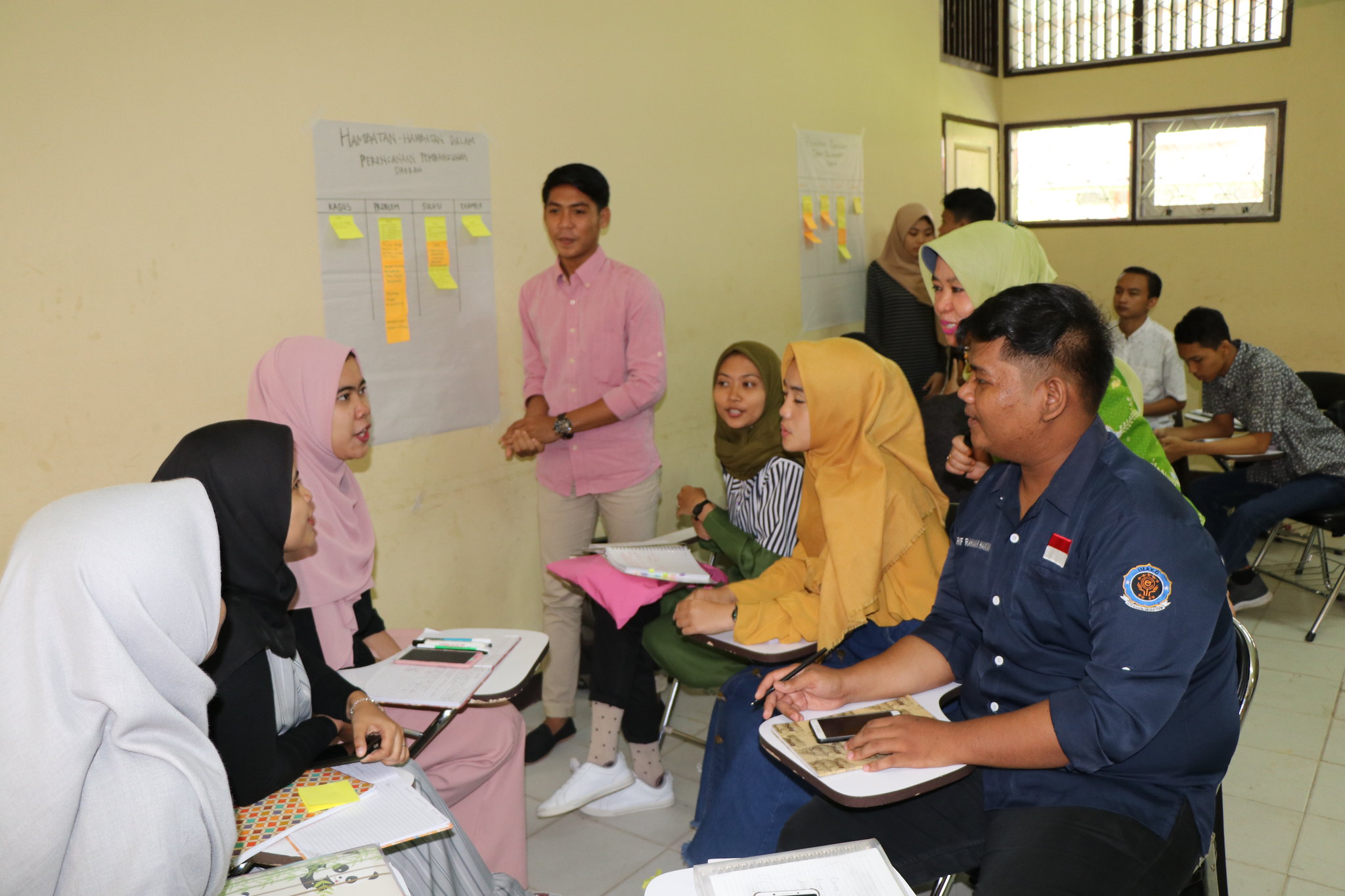
• 150 Students Inaugurated as TELADAN 2020 Participants

    150 Students Inaugurated as TELADAN 2020 Participants

    One hundred and fifty participants of Tanoto Foundation’s TELADAN 2020 program were officially inaugurated as Tanoto Scholars at a recent event that took place at Bandung Institute of Technology (ITB) on February 6.

    The TELADAN (Teaching Leadership, Advancing the Nation) Program participants were selected out of close to 10,000 applicants, after successfully passing through three stages of selection, including competency and personality assessments as well as interviews.

    Tanoto Scholars each receive 100 per cent tuition support and a monthly allowance from the time they are confirmed as a Scholar until their final semester. In addition, they are also provided with the opportunity to be part of a structured leadership development program including a global study abroad experience, extensive career development guidance and leadership development.

    Satrijo Tanudjojo, Global CEO of Tanoto Foundation, stressed that the TELADAN Program showcases the Foundation’s harmonious partnership with universities to jointly provide leadership solutions and equip students with the skills needed by the job market.

    Tanoto Foundation, an independent family philanthropy organisation founded by Sukanto Tanoto and Tinah Bingei Tanoto in 1981, currently partners nine universities to run the TELADAN Program.

    The TELADAN Program aims to instill integrity, compassion, innovation, grit, motivation, global thinking as well as an entrepreneurial spirit in its participants, he said.

    “Technology is growing very fast and impacting all aspects of life, including the job market. A McKinsey study in 2019 reveals that 23 million jobs in Indonesia will disappear in the next 10 years, because of advanced information technology or artificial intelligence.

    “However, the same study also reveals that 27 to 46 million jobs will be created as a result of advancements in technology. With our TELADAN program, Tanoto Foundation, together with our partner universities, wants to prepare young people to be ready to enter the workforce and become role models in society,” Satrijo Tanudjojo said.

    The TELADAN Program was launched on September 6, 2018, as a continuation of the scholarship and leadership program that Tanoto Foundation started in 2006. It is designed to equip Indonesia’s future leaders with the various characteristics, values and skills required to contribute positively to the environment in which they live and work.

    The program is also in line with the Indonesian government’s 2020-2024 National Medium-Term Development Plan (RPJMN) which aims to strengthen productivity and education as a pillar of human resource development.

    To date, Tanoto Foundation’s scholarship and leadership programs have benefitted 7,650 students throughout Indonesia.

  • The Independent Campus Policy: A Bid to Remove Students’ Horse Blinders

    The Independent Campus Policy: A Bid to Remove Students’ Horse Blinders

    by: Professor Sri Minda Murni

    Professor at Medan State University & Tanoto Foundation TTI Development Coordinator. Tanoto Foundation is an independent family philanthropy organisation founded by Sukanto Tanoto and Tinah Bingei Tanoto in 1981.

    In January, the Minister of Education and Culture Nadiem Makarim launched the ‘Independent Campus’ (Kampus Merdeka) higher education policy in Indonesia. There are four components to the policy:

    1. Establishment of new courses / majors
    2. Automatic re-accreditation
    3. Freedom of legal status change for some state universities, and
    4. Ability for students to take up courses beyond their majors as semester credit

    I find the fourth component to be particularly intriguing. It gives the right to students (except those studying medicine) to voluntarily take up courses outside of university for up to two semesters, which is equivalent to 40 semester credits. Students are also allowed to take up courses which are part of their major, but still within the university, for one semester. All in all, it is only compulsory now for five out of eight semesters of study to be within the students’ own study major.

    Learning freedom for students

    Under this new policy, the definition of ‘semester credit’ which was previously synonymous only with in-class learning has now broaded into other activities such as internships, student exchanges, entrepreneurial projects, research projects, independent studies, teaching in remote areas and military training. This breakthrough allows students to have choices about how they can fulfill their semester credit requirements with programs provided by the government or alternative programs with the University Rector / Director’s approval, all with the guidance of their university mentors.

    This ‘Freedom of Learning’ option for higher education students, if implemented properly with keen enthusiasm, is an innovative way to answer the challenge faced by modern higher education institutions in preparing quality human resources who are in line with 21st century demands.

    Professional world’s challenge

    The working world is complex and in reality, there is no guarantee that a ‘link-and-match’ can be facilitated between accumulated knowledge and experience in university and proficiency at a job. Subsequently, assumptions arise that undergraduates are readily-built-resources rather than ready-to-work ones, as there is a more pragmatic approach in the professional world when compared to the more theoretical approach in university.

    On the other hand, professional world also frequently face inefficient problem solving processes which tend to be “reinventing the wheel” or doing something from scratch due to lack of references. Whereas, if the professional world are able to utilize theoritical knowledge gained while their people were in universities, problem solving can be more efficient, effective and always based on proven theories.

    Real world learning

    Ideal graduates are those who have the know-how to utilise their theoretical knowledge by applying it towards practical solving of real-world problems. This capabiltiy only develops if students are given the chance to gain semester credits outside of university – including from their actual industries – through various activities and projects which support experiential learning as these help the students to become familiar with linking textbook theories to strategic problem-solving in the real world.

    People from the professional world frequently complain about how many university graduates don’t have the capability to think logically, or willingness to showcase their intellectual maturity. One reason is they have limited scholarly mobility, whereby their logical thinking capabilities do not develop due to lack of knowledge outside of their fields of study. If they are able to gain broader knowledge beyond their study area, the premise should be that mastering and developing knowledge that is within their own fields of study should be easy.

    Removing the horse blinders

    Students lacking exposure to other areas of study tend to view problems with tunnel vision – like a horse wearing blinders. In fact, there is a misconception that many areas of study do not have significant contribution to our lives. Literature studies, for example, have always been played down because it is often mistakenly assumed that literature students only learn about language. Yet, literature is useful in better understanding a nation’s history, sociology and political spectrum. A student would not be able to understand the history of slavery and civil water in the United States, if they do not read about the bitter experiences that some Americans lived through which are depicted in literature works from that period.

    I think intellectual adventures that occur from venturing into different areas of study (beyond their own) will liberate and improve students’ critical thinking and problem-solving abilities, as the experience provides them with the opportunity to contemplate issues with different viewpoints.

    Realizing the policy

    Of course, careful planning and an intensive control system is needed in realizing this policy, especially when resources are limited. University lecturers, including guest lecturers, should have had adequate experiences and have enjoyed the benefits of off-campus learning and cross-major studies themselves.

    With this policy in place, it is hoped that our students will no longer be mere names and signatures inked on administrative documents, but rather scholars with highly-developed critical thinking and practical skills who are ready to face challenges in the working world.

    This article is a translation of “100 Hari Nadiem Makarim: Kampus Merdeka, Upaya Melepas “Kacamata Kuda” Mahasiswa” article first published in Kompas.com

  • Tanoto Foundation and Yogyakarta State University Collaborate To Improve Basic Education Quality

    Tanoto Foundation and Yogyakarta State University Collaborate To Improve Basic Education Quality

    Yoggakarta State University (UNY) is collaborating with Tanoto Foundation, an independent family philanthropy organisation founded by Sukanto Tanoto and Tinah Bingei Tanoto in 1981, to improve the quality of basic education in Indonesia with the PINTAR Program.

    This collaboration was marked by the signing of a Memorandum of Understanding (MoU) and Cooperation Agreement between UNY Rector/President Prof. Dr. Sutrisna Wibawa and Tanoto Foundation Basic Education Director Margaretha Ari Widowati, in the presence of Tanoto Foundation Global CEO J Satrijo Tanudjojo, in the UNY Main Assembly Hall in Yogyakarta on January 13, 2020.

    PINTAR has trained and assisted teachers, principals, school superintendents, committees and lecturers to better work together in improving students’ learning results, Tanudjojo explained. Under PINTAR, pre-service teacher students at the UNY Teachers’ Training Institute (TTI) will receive training so that they will be able to provide quality education by the time they graduate. Tanudjojo added that the collaboration with UNY is meant to facilitate TTI lecturers to implement a practical learning process for the pre-service teacher students.

    “Tanoto Foundation will work with the UNY lecturers and experts to prepare pre-service teachers at TTI to acquire practical teaching experience. So when they graduate, they can create lively and active learning classes. This is in line with the criteria of our MIKiR (Experiencing, Interacting, Communicating and Reflecting) active learning method,”

    Tanudjojo said.

    Meanwhile, UNY Rector/President said this collaboration provides invaluable real experience to the pre-service teachers about school-related issues and encourages them to seek solutions. She also said UNY has developed innovative learning methods which are available for further development in collaboration with Tanoto Foundation.

    “UNY has various findings about learning models which are open for synergy with Tanoto Foundation. The Foundation has a broad experience in education, and our lecturers should take advantage of the opportunity to work together with them in order to improve Indonesia’s education quality,” Prof. Wibawa said.

    UNY and Tanoto Foundation’s collaboration will run until December 2021, with discussions expected after to determine further collaboration in future years.

    Both organisations are also expected to nominate a number of UNY lecturers to become lecturer facilitators who will select partner schools to provide trainings and assistance at, as well as develop collaborative studies with, as part of strategic efforts to position the TTI as a service provider to improve education quality.

    Tanoto Foundation’s collaboration with UNY marks the tenth time it has worked with a partner TTI.